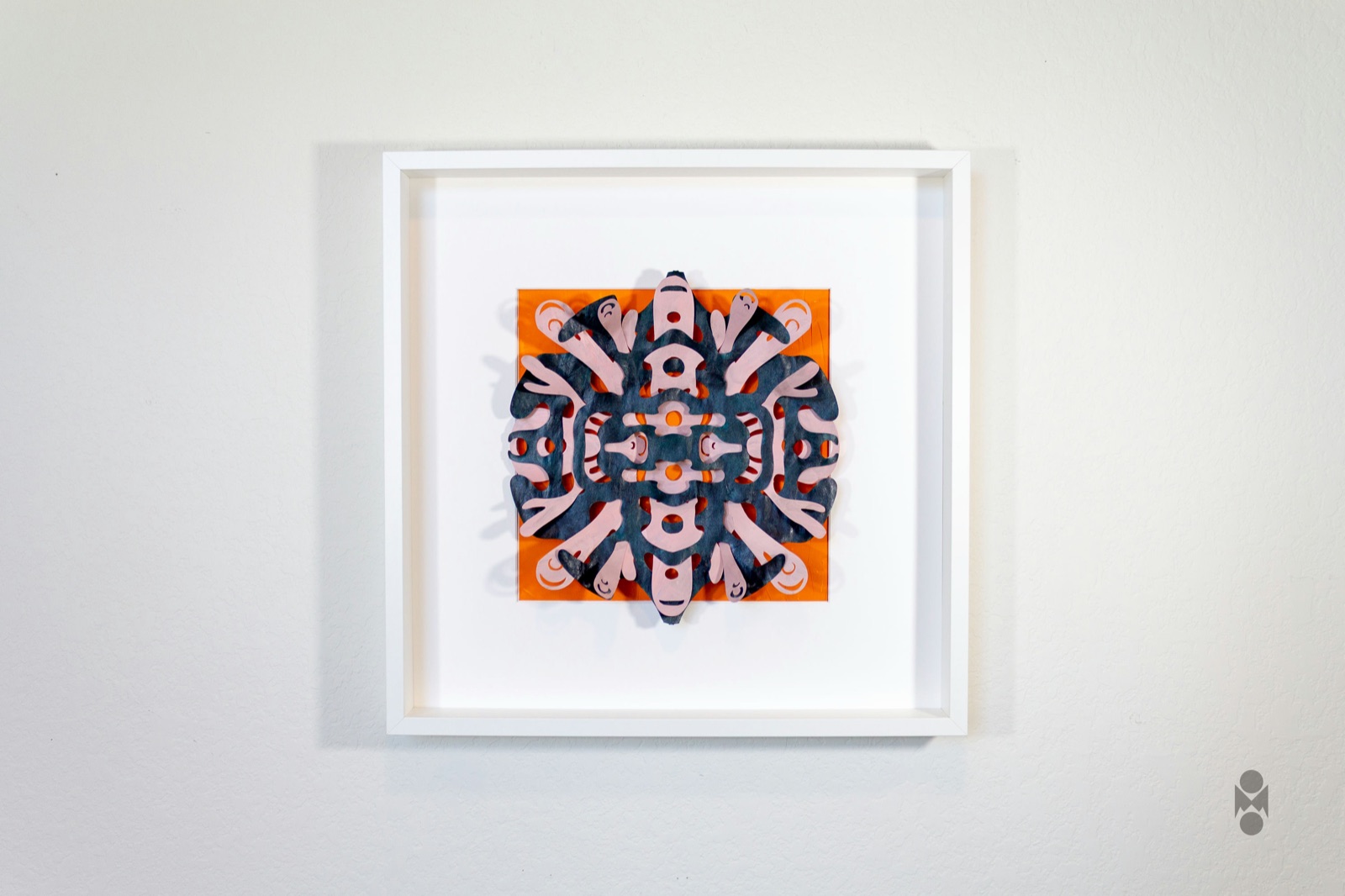
Cnidarian:(Warm Perception)
Cnidarian:(Warm Perception) · 2025 · Mixed Media on Paper · 19.75 x 19.75 x 2 in.
A radially symmetric cut-paper form arrives at the structural geometry of a cnidarian: tentacular projections, oral disc, and radial canals in layered paper, ink, and acrylic. Blush and slate blue forms float above a luminous orange substrate, so the organism's plan and the cut pattern read as one drawing.
- Medium
- Mixed Media on Paper
- Substrate
- Paper
- Dimensions
- 19.75 x 19.75 x 2 in.
- Edition
- Unique
- Status
- Sold
- Inventory
- AX-2025-003
- Scale
Drawn to scale from the recorded dimensions, against a sofa. Not a photograph of an installation.
From the series Cnidarian
Cnidarian:(Warm Perception) constructs a bilaterally and radially symmetric organism from cut, painted, and layered paper; a material body that reads simultaneously as jellyfish, mandala, and circuit schematic. The work is built from two primary strata: a vivid orange backing that functions as both ground and light source, and an intricate cut-paper form painted in slate blue and blush that hovers above it within a deep shadow-box frame. The negative spaces cut through the upper layer allow the orange substrate to pulse through; mimicking the translucency of cnidarian tissue, the bioluminescent glow of deep-sea forms, or the backlit logic of a synthetic display. The composition is organized around a central axis with four-fold symmetry, extending outward through repeating lobes, apertures, and tapered projections that suggest tentacles, nematocysts, oral arms, and velum. The hand-painted surface introduces material irregularity; the blue-gray wash is uneven, oxidized in appearance, recalling preserved biological specimens, aged industrial surfaces, or the patina of synthetic membranes under stress. Small crescent and circular cutouts punctuate the field, functioning as both anatomical detail and decorative mark. Within Axioma's broader practice, this work advances the thesis that categorical distinctions between the biological and the synthetic are constructions rather than facts. The cnidarian; among the oldest animal phyla, radially organized, nervous-system-minimal; becomes a site for examining how pattern, symmetry, and material behavior operate across organic and engineered systems. Warm Perception names not only the chromatic temperature of the orange field but an epistemological condition: to perceive warmth, to register sensation, as a function shared by tissue and sensor alike.