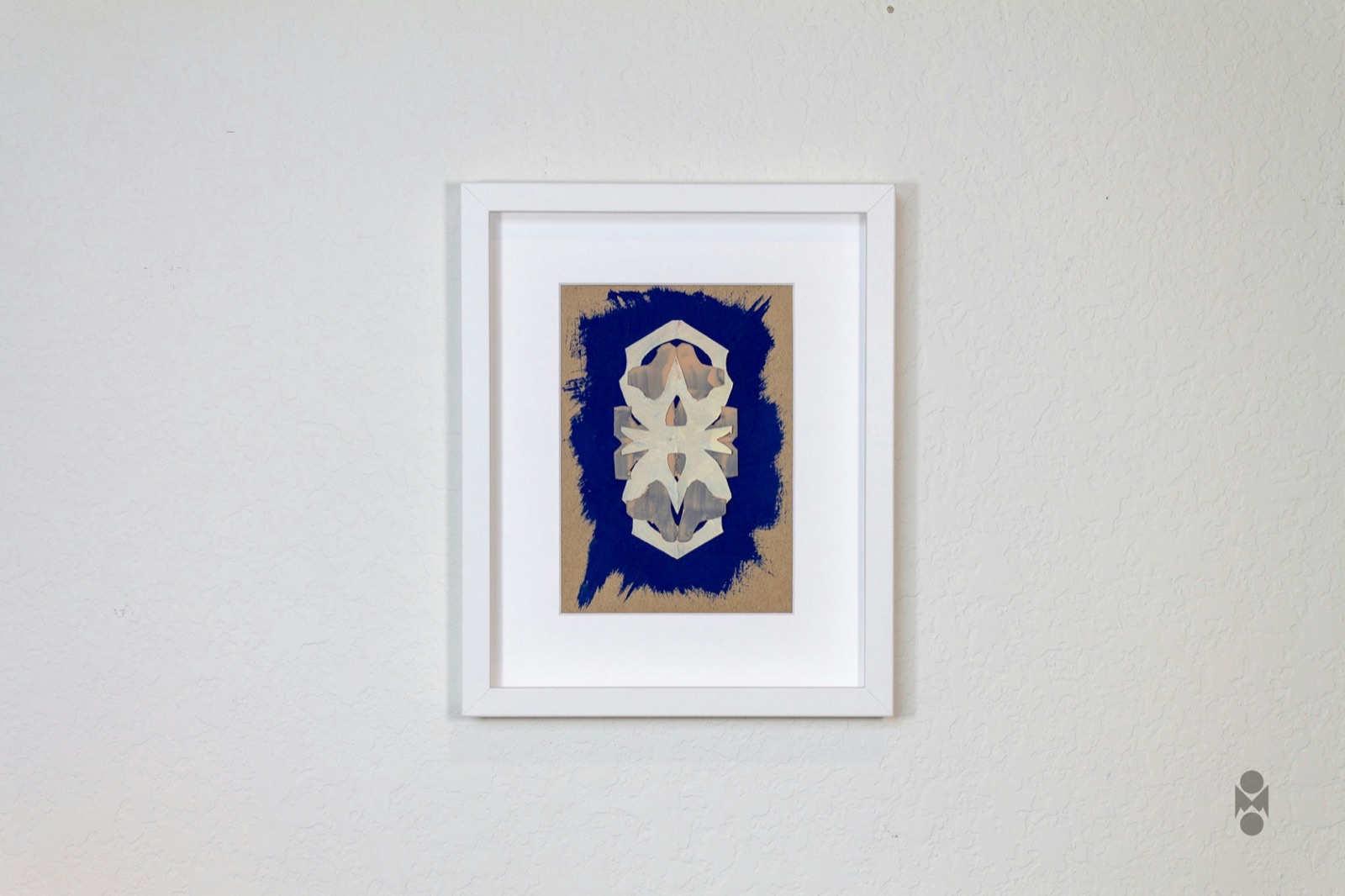
Quetzal Skull Specimen:(Bone & Skin)
Quetzal Skull Specimen:(Bone & Skin) · 2025 · Mixed Media on Paper · 7.75 x 5.125 in.
A symmetrical, glyph-like cut-paper composition in white and silver tones set against a deep blue acrylic field on recycled cardboard, holding the quetzal skull and the ceremonial mask in a single form.
- Medium
- Mixed Media on Paper
- Substrate
- Cardboard (cat food box), paper from museum maps, and paint sample cards
- Dimensions
- 7.75 x 5.125 in.
- Edition
- Unique
- Status
- Available
- Inventory
- AX-2025-010
- Scale
Drawn to scale from the recorded dimensions, against a sofa. Not a photograph of an installation.
From the series Specimens
This work is available in the current collection.
Inquire about this work →
Quetzal Skull Specimen (Bone & Skin) is a small-scale, symmetrical cut-paper composition that operates at the threshold between biological relic and ceremonial glyph. Constructed on recycled cardboard salvaged from a cat food box; its industrial origin embedded beneath layers of deep blue acrylic; the work grounds itself in material that has already cycled through systems of consumption and discard. Museum map paper and paint sample cards are cut and layered into a bilateral form that reads simultaneously as skull, mask, and specimen: a thing preserved, pinned, and presented for study. The central figure emerges in white and silver tones against the saturated blue field, its cut edges precise and architectural, suggesting both the structural logic of bone and the decorative language of pre-Columbian iconography. The Quetzal; a bird historically bound to ideas of divinity, sovereignty, and the boundary between worlds; is here reduced or distilled to its skeletal implication: what remains when living color is stripped away. And yet the silver tones introduce something synthetic, something reflective and contemporary, so that the specimen is never purely ancient. It holds both registers at once. The work enacts Axioma's core thesis through material and form: the cardboard substrate is simultaneously industrial waste and support for ritual image-making; the paper sourced from museum maps carries the memory of institutional classification systems while being cut free of that logic into organic, symmetrical life. There is no clean line here between the natural and the manufactured, between the archaeological and the everyday. The skull does not mourn. It classifies; and in doing so, refuses the categories it appears to invoke.